
Investing by looking at the price moves vs looking at the value

(published on Substack on 10 Mar 2026)
I often hear from people and get messages about price moves, especially when the stock drops from the purchased level. In value investing, the cheaper the stock, the better the return, subject to the analysis that the fundamental factors support the thesis of buying the stock in the first place.
I am always perplexed when people sell their stocks once the price drops from their purchase levels, and then, when the fundamentals kick in, they start re-entering the cycle with lower returns or usually at the peak of the price level.
The chart below is my favourite one of annualised 10-year returns of an average investor vs the S&P 500:
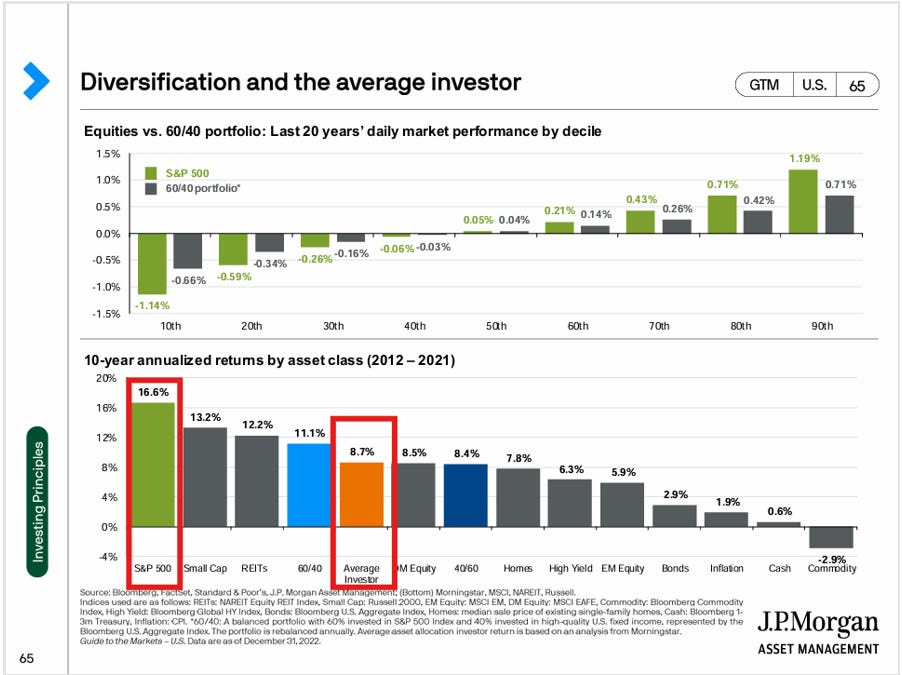
Source: JP Morgan, Guide to the Markets 1Q2023
As you can see, the average investor’s return was 8.7 per cent vs 16.6 per cent of the S&P 500. Now, the question is: what leads to such poor performance? I think the answer lies in temperament. Warren Buffett warned value investors as follows: “Until you can manage your emotions, don’t expect to manage money”. So, when we look at the stock of a particular company and buy it with a margin of safety and do our analysis that fundamental factors shall support the upward trend, and the price drops, we have to be appreciative, as it gives us the opportunity to buy more of the same stock.
I like to compare the above with the supermarket analogy. Let’s assume we go to a supermarket and one of the products that is qualitative and is being used in our household is on discount, we won’t buy only one item, will we? We will buy 2-3 to take advantage of the price. We, as value investors, have to apply the same principle in investing.
While we hold the purchased stock, we get the dividends and reinvest them into the stock or apply the dollar average every month, which will increase the returns. We shall avoid doing the same thing when the stock is going up, as in this case, the low-risk/high-return concept is becoming riskier once the price starts going up. Whereas in the former case, we are getting more shares for less money and thereby increasing our returns with a low-risk/high-return option.
Benjamin Graham, the famous value investor and author of the book “The Intelligent Investor”, described the market pace perfectly:
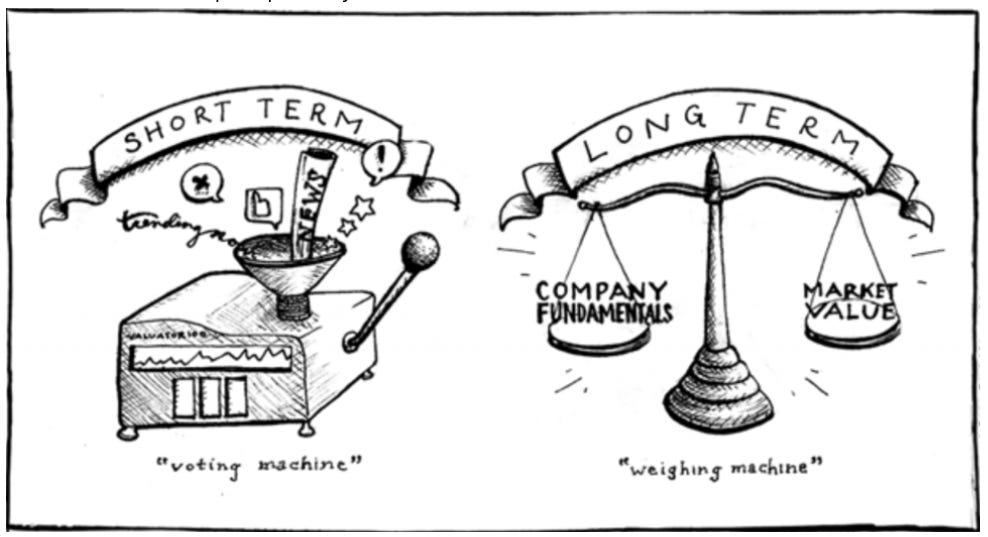
Source: The Intelligent Investor
Namely, in the short run, the price movement of a stock is just pure noise, and we as value investors shall ignore it at any cost. But once the fundamental factors kick in and the market participants recognise the value of these factors, then the company’s value is reflected in its price.
The only advice I can give you, my fellow value investors, is not to succumb to the emotions and stay calm when the price of the purchased stock is going down and evaluate if the analysis and fundamental factors still support the thesis.
If you have any questions, please contact me or leave comments, and I shall do my best to shed light on the matter.
Thank you for reading,
Value Investor in Shipping
Disclaimer: It is not financial advice but a research-based fundamental analysis.
Substack link: https://valueinvestinginshipping@substack.com