Outlook on the LPG sector in 2026
(published on Substack on 03 Mar 2026)
Today’s topic is the LPG sector of the shipping industry, which includes LPG vessels.
The sector is very important for the global economy. I won’t digress much, but I would like to shed some light on the fact that LPG (Liquefied Petroleum Gas), usually a mixture of propane and butane (both are petrochemicals), is used as a fuel in both the household and industrial sectors. So, the subject commodity is crucial to fuel the economy in terms of the supply of power and other applications.
To transport the aforementioned commodity, the market players hire vessels that carry cooled propane and butane from the ports of loading to the ports of discharge.
Supply and demand of LPG
According to MMR (source: https://www.maximizemarketresearch.com/market-report/global-lpg-market/116743/), the LPG market size is slated to increase from USD 176.52B in 2025 to USD 276.13B in 2035, meaning that the production and consumption of LPG are forecasted to increase. Notably, according to Index Box (source: https://www.indexbox.io/blog/liquefied-petroleum-gas-lpg-world-market-overview-2024-5/), China (96 million tons) and India (39 million tons) were the largest consumers of LPG in 2024, followed by the USA (27 million tons).
And the countries of the Asian region are slated to consume more LPG compared to 2025. According to FGE (source: https://www.fgenergy.com/ngls/ngl-annual-reports/the-lpg-forecast-2025-edition/), LPG imports to Asia as a consuming region will surge from 87 million tons in 2023 to 120 million tons per year in 2030.
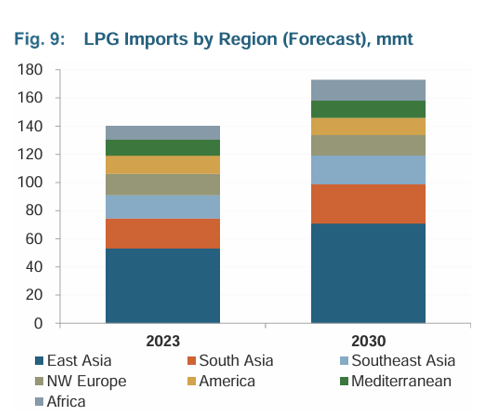
Source: FGE
It is worth noting that the US Gulf and the Middle East are the biggest suppliers of LPG globally and especially to Asia, and the United States are considered the largest LPG-producing country. Due to economies of scale and distances, most propane and butane volumes are loaded on VLGC (Very Large Gas Carriers with a cargo capacity of 70,000-90,000 cubic meters and deadweight of around 50,000-60,000 tons). According to BW LPG’s presentation (source: BW LPG, September 2025), 70 per cent of LPG is being shipped on VLGC from the US Gulf to Asia (via the Panama Canal). Total LPG exports from the US Gulf and the Middle East on VLGCs can reach up to 110 million tons:
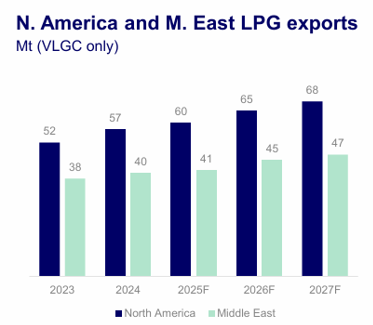
source: BW LPG
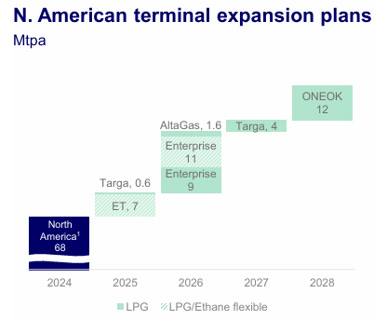
Now, apart from the above, the USA are scheduled to increase their export capacities in 2026 and onwards by adding more infrastructure. Namely, in 2026, Enterprise Products Partners L.P. will add more export capacity via its Neches River (10.6 million tons p.a.) and Marcus Hook (8.8 million tons p.a.) facilities:
source: BW LPG
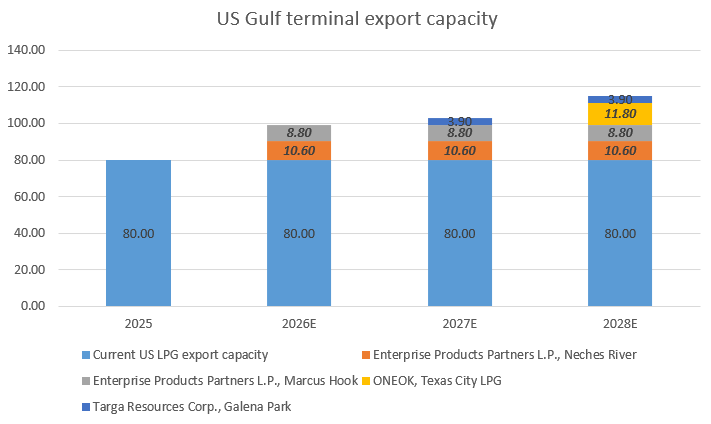
Targa Resources Corp. will add 3.9 million tons per year in 2027 via its Gelena Park infrastructure. In 2028, ONEOK will add around 11.8 million tons of LPG in Texas City LPG to the established and projected export volumes. If we add the above-mentioned volumes to the 2025 export volumes ex US Gulf, we will get the following picture:
Source: Internal analysis
By adding the above figures, we get projected annual export volumes of 99.40 million tons in 2026, 103.30 million tons in 2027 and 115.10 million tons in 2028.
Apart from the above additions to the global export capacity, the Middle East is also slated to add more export volumes from Qatar (133k barrels per day from North Field East in 2026 and 60k barrels per day from North Field South in 2027), which, combined with the current export capacity, will add an extra 14 VLGC liftings per month (source: https://www.oilandgasmiddleeast.com/news/middle-east-lpg-exports-growth). Saudi Arabia is planning to add 70k barrels per day of LPG in 2026, while the UAE is expected to add 22k barrels per day of LPG in 2026.
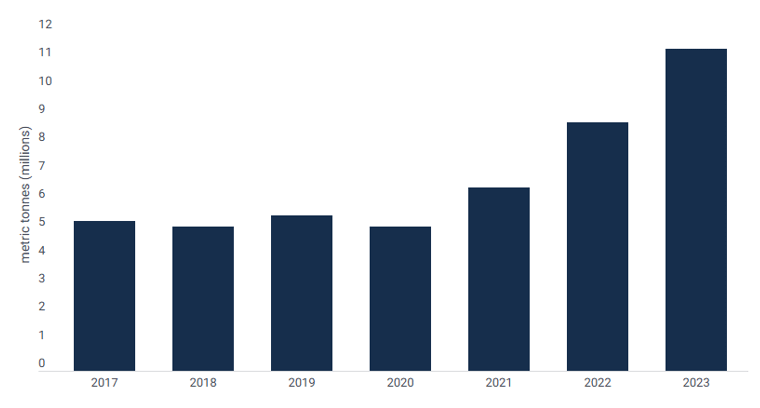
Let’s not forget about Iran, whose export volume was around 10-11 million metric tons in 2025 and from 2017, the export volumes doubled:
Source: Lloyd’s List
So, we have a healthy supply and demand of LPG in 2026 and onwards.
LPG vessels’ current fleet and the outlook
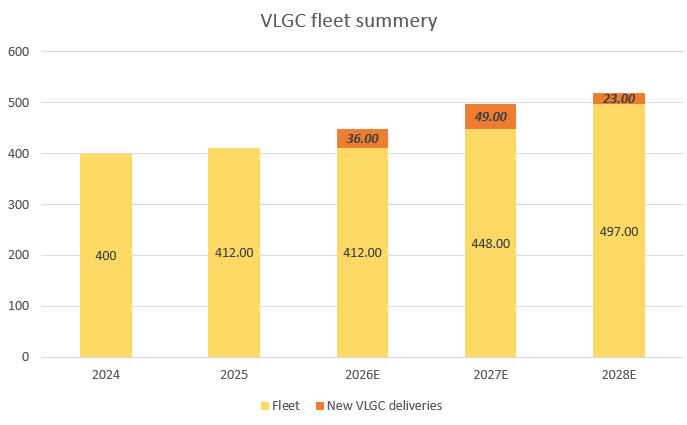
As of today, as per my calculations, there are around 412 VLGC vessels, with 12 vessels delivered in 2025.
Source: Internal analysis
From the above table, we can expect the total VLGC fleet to be 448 in 2026, 497 in 2027 and 520 in 2028. The question is: will the growth rate of new VLGC deliveries be absorbed by the export growth capacity from the US Gulf and the Middle East terminals? My fundamental analysis and modelling show that it will, with high probability.
According to BW LPG, around 16 per cent of VLGCs are around 15-20 years old (source: BW LPG, September 2025).
What to expect from the LPG sector in 2026?
By projecting the daily earnings/TCE of VLGC for 2026 and taking into account both the supply and demand of LPG and the supply of the new VLGC deliveries, I get the following picture:
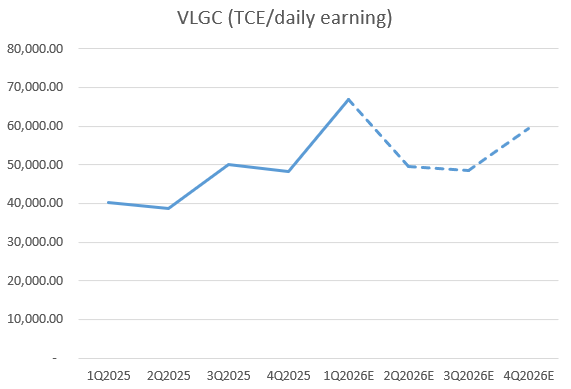
Now, the 1Q2026 of USD 67,000 per day was calculated before the weekend, and the situation in the Middle East. The actual figures for 1Q2026 should be higher (I reckon around USD 80,000-85,000 per day), but as of now, it is difficult to calculate precisely due to a lot of moving parts in the current picture, as let’s not forget the Middle East exports around 40-41 VLGC stems per year and plays a crucial role in the supply of LPG.
Nevertheless, the current situation in the Middle East changed the pre-weekend picture of the daily earnings/TCE and, of course, the prices of publicly listed companies that are engaged in the LPG shipping business soared too. So, all the risk premiums have already been taken into account by the market.
Risks
As with any investment, there are risks. The LPG industry is very sensitive to macroeconomic factors such as demand and economic growth, and one should bear in mind that if any of the macroeconomic factors falter and hint at reduced demand, the daily earnings/TCE shall go down, which will lead to a respective change in the stock price.
Conclusion
By looking at fundamental factors and analysis laid out above, we have:
- A healthy supply and demand of LPG;
- New deliveries of VLGCs to the existing fleet; and
- A strong conviction that the growth rate of the new VLGC deliveries will be absorbed by the growth rate of the new commissioned export capacities from the US Gulf and the Middle East in 2026 and onwards.
The above shall lead to healthy daily earnings/TCE throughout 2026 and onwards, and the companies that are engaged in the transportation of LPG shall benefit from the projected outlook. As per my projections, the average daily earnings/TCE for VGLC in 2026 should reach USD 56,125 per day vs USD 44,393 per day in 2025.
If you have any questions, please contact me or leave comments, and I shall do my best to shed light on the matter.
Thank you for reading,
Value Investor in Shipping
Disclaimer: It is not financial advice but a research-based fundamental analysis.
Substack link: https://valueinvestinginshipping@substack.com